
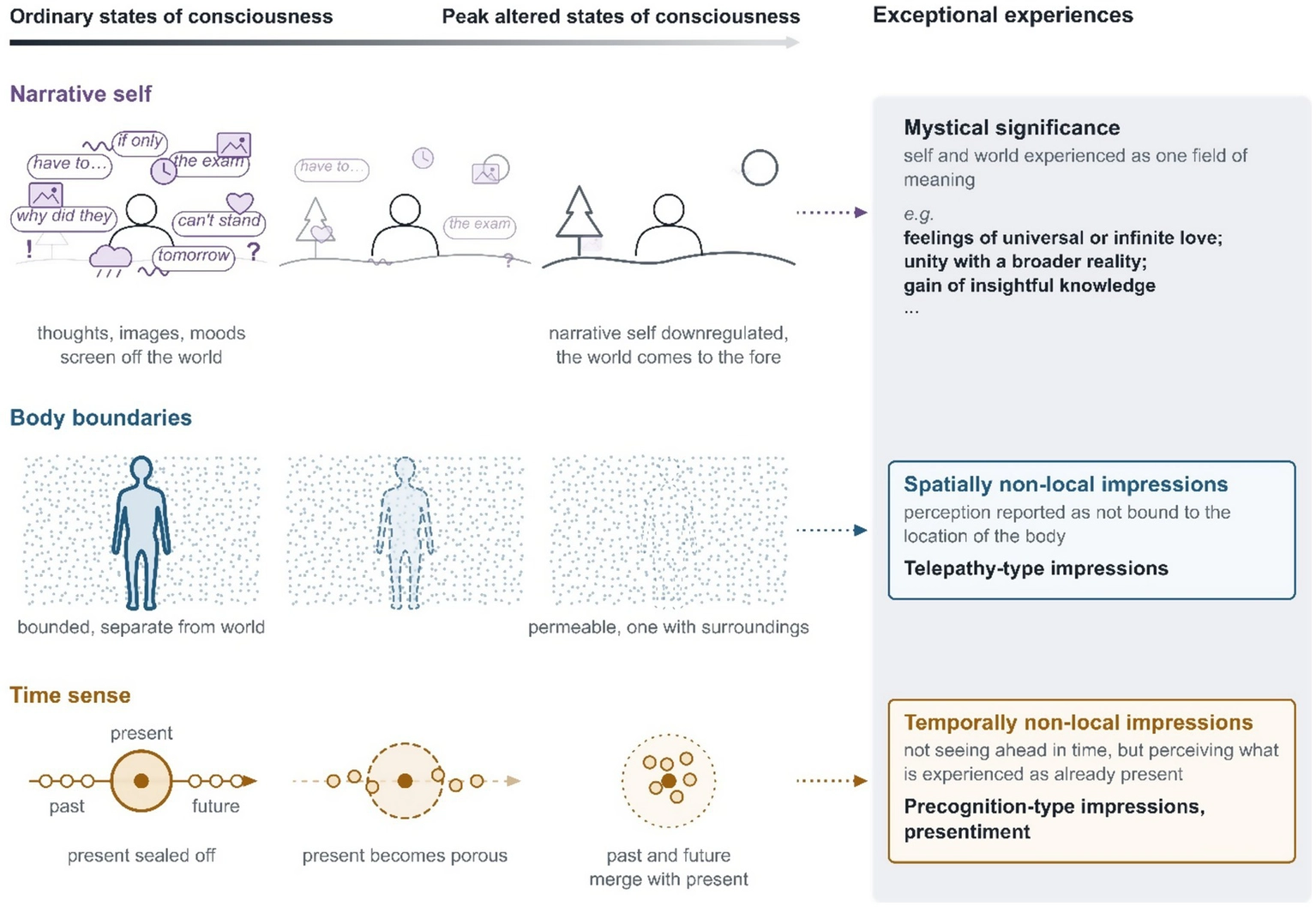
A paper published in Frontiers in Psychology on 6 November 2026 examines what its author calls “exceptional experiences”: reports including apparent precognition, telepathic impressions, unusual coincidences and anomalous cognition.
Marc Wittmann’s article is a Hypothesis and Theory critical review, not a new laboratory experiment. It considers meditation, psychedelic states and Floatation-REST, asking whether weakened body boundaries, a reduced narrative self and changed time perception could help researchers investigate experiences that seem to extend beyond the ordinary self, time and space.
The paranormal connection—and the limits
The paranormal relevance is direct: the paper discusses experiences often interpreted as psi or evidence of non-local consciousness. Its position is more cautious than that interpretation. Wittmann notes that reported effects are generally small, replication is inconsistent and the available findings do not prove that consciousness operates independently of the brain or receives information outside conventional sensory routes.
One Floatation-REST study discussed in the review found no overall psi effect, although the depth of the altered state correlated with performance within that study. A correlation inside one study is not confirmation of a paranormal mechanism.
Research finding or research proposal?
Verified: This is a peer-reviewed, open-access theoretical review published on 6 November.
Research finding: The reviewed literature contains unusual reports and some associations, alongside small effects and replication problems.
Hypothesis: Altered states may offer a useful setting for more controlled testing of exceptional experiences.
Not established: The paper does not demonstrate telepathy, precognition, psi or non-local consciousness.
Why today: On a quiet news day, this recent review gives paranormal readers a serious, discussion-worthy question while preserving the distinction between subjective experience, suggestive results and proof.