
There is something particularly unsettling about the idea of a voice that nobody heard until the recording was played back.
A photograph offers a shape to examine. A strange noise offers a moment to remember. An apparent voice seems to offer something more personal: someone trying to speak.
That is the fascination behind electronic voice phenomena, usually shortened to EVP. The term describes recorded sounds interpreted as voices of spirits or the dead. Calling a sound an EVP, however, does not establish who—or what—produced it.[1]
From birdsong to voices
One of the best-known stories in EVP's history begins with an apparently ordinary recording.
Psychologist Imants Barušs's historical review describes Friedrich Jürgenson reporting a voice in birdsong recordings in 1959. Jürgenson interpreted subsequent messages as communication from the dead.
Konstantin Raudive became interested in those claims and began his own experiments in 1965. His book Breakthrough, published in English in 1971, helped bring the subject to a wider audience.[1]
These accounts document the development of an idea. They do not independently verify the claimed speakers.
Famous recordings: what is actually being claimed?
The Raudive voices: a message—or a broadcast?
Raudive's recordings became a landmark in EVP history. But their interpretation was contested. Barušs's review describes an examination by researcher J. Keil of a passage Raudive treated as a particularly clear example. Eight native German speakers recognised German speech whose likely source was an Easter radio broadcast; Raudive had interpreted it using several languages.[1]
This illustrates two separate possibilities: genuine speech entering a recording from an ordinary source, and a listener assigning different words to it. Neither requires the listener to be dishonest. A recorder can capture speech without capturing a spirit.
The Queen Mary: the child said to finish a song
The Queen Mary's paranormal reputation includes a purported child spirit called Jackie. In its own evidence archive, the San Diego Paranormal Research Society describes a 2008 pool-area recording in which Nicole Strickland sang a familiar nursery rhyme but left out its final word. The group interprets a subsequent sound as a young female voice supplying “down”. Its archive also describes a 2011 recording interpreted as a child identifying herself as Jackie or Jacqueline.[4]
These are the investigators' interpretations, not independently established identities. The same archive says Jackie's origins remain elusive.
Why might such a recording feel persuasive? A missing word creates a very specific expectation. An ambiguous sound can then seem to complete the exchange. The priming research discussed below gives us a reason to test that interpretation without first telling listeners the expected answer.[2],[3]
An ordinary voice picked up from elsewhere is another possibility to investigate. That requires the full recording and information about people, adjoining spaces and equipment. It is a proposed check, not a demonstrated explanation for these particular clips.
A separate Queen Mary investigation report from the Ghost Research Society, dated 25 April 2024, offers a revealing example. An editor notes that a supposed voice in a clip labelled “Try me” resembles investigator Dale Kaczmarek, whose lips were moving at the relevant moment.[5] It is a concrete reminder that a living participant must be considered before declaring a voice disembodied.
Enfield: famous recorded voices, but a different question
The Enfield poltergeist investigation produced extensive recordings of the harsh voice associated with Janet Hodgson, including the identity “Bill Wilkins”. The Society for Psychical Research's account describes investigators hearing the voice during sessions and examining Janet's vocal production.[6]
The famous voice is therefore a different kind of claim from a phrase discovered only on playback. It should not casually be presented as a classic EVP.
The SPR account reports that tests suggested ventricular phonation, involving structures in the larynx above the usual vocal folds, as a possible mechanism. Investigators disputed whether that adequately explained the observations.[6] The relevant scientific question concerns human voice production and the conditions of the demonstrations. Merely recording an unusual voice does not demonstrate that its speaker was a deceased person.
Hearing a voice is only the first question
An apparent voice presents several separate puzzles.
Is there speech in the recording? What does it say? Where did it come from?
Those questions are easy to merge when a clip arrives with a confident caption. Yet recognising something that sounds like a word does not identify its source. Nor does failing to identify that source establish a supernatural explanation.
Even sincere listeners can disagree about what they have heard.
In a study published in the 2015 volume of Applied Cognitive Psychology, Michael A. Nees and Charlotte Phillips compared listeners' responses to purported EVP, ordinary speech, degraded speech and noise. Some participants were told the experiment concerned paranormal EVP; others were told it concerned speech intelligibility.
The paranormal introduction increased how often participants reported voices in EVP and degraded speech. When listeners detected a voice in an EVP sample, agreement about the message's content was low.[2]
The unsettling implication is that hearing a voice and understanding a message are different achievements.
What expectation brings to the recording
Auditory pareidolia describes hearing meaningful patterns, such as words, in ambiguous sound. It is the auditory counterpart of seeing a face in a cloud.[3]
That gives us a reason to be careful with subtitles: a suggested phrase may influence the interpretation we bring to a recording.
The research also deserves careful treatment. A 2022 study by Jess M. Williams and Mark Blagrove, involving 61 participants, only partially replicated the earlier priming findings. It did not find that the group given a paranormal introduction reported more voices in EVP and degraded speech than the other group.[3]
Expectation matters as a possible influence; these studies do not justify claiming that every listener reacts identically, or that every disputed recording has been explained.
What happened when researchers tried recording their own?
Barušs also attempted to reproduce EVP using radios tuned between stations and recordings made across 81 sessions, totalling approximately 60 hours and 11 minutes.
Some sounds resembled voices. His conclusion was that none of the recorded phenomena was clearly anomalous, much less attributable to beings without bodies.[1]
That result concerns the methods and recordings in that experiment. It cannot settle every recording anyone has ever made. It does demonstrate why finding a voice-like sound is a much lower threshold than demonstrating contact with the dead.
The Panasonic RR-DR60: when the recorder becomes part of the mystery
Some equipment acquires a paranormal reputation of its own. The Panasonic RR-DR60, a late-1990s digital dictation recorder, is a prominent example. Investigator Kenny Biddle describes its adoption by ghost hunters and its reputation for capturing alleged spirit voices despite poor sound quality.[7]
The reason to scrutinise it goes beyond its age. Panasonic's service manual explicitly lists periodic honking noises and playback of erased audio among possible faults, linking them to problems in the organisation of flash memory.[8]
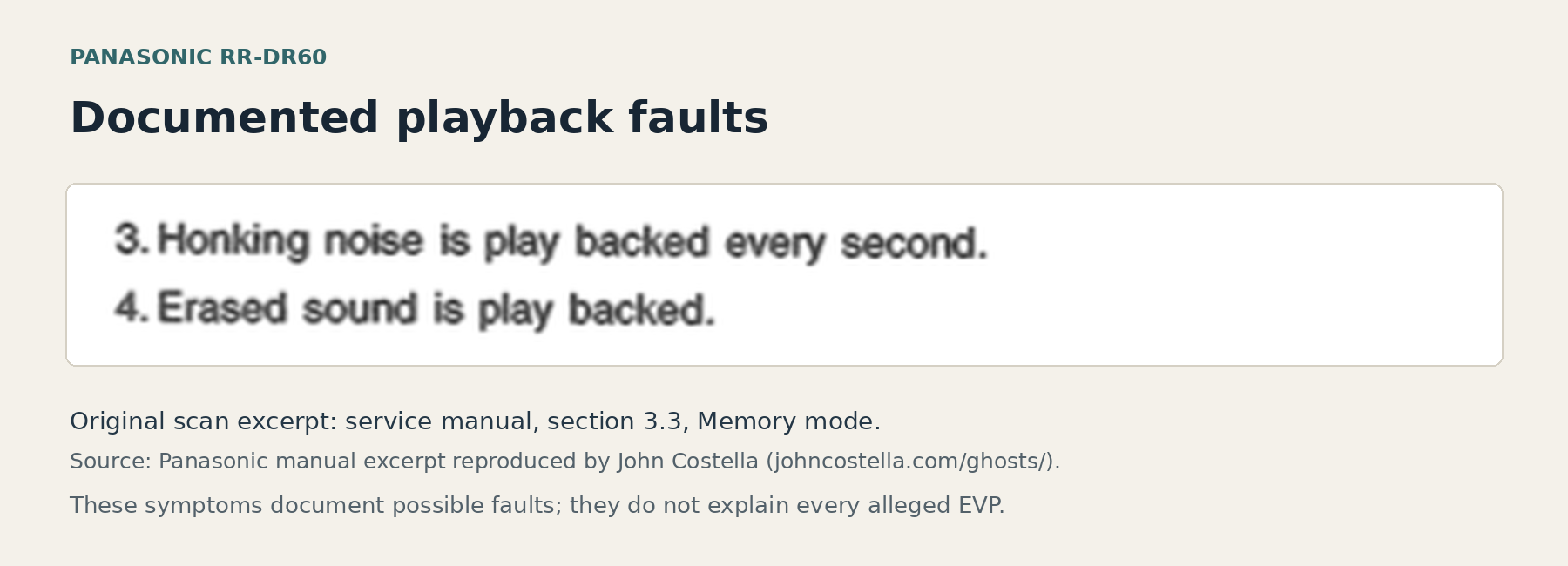
That is manufacturer-documented behaviour capable of producing unexpected playback. It is not a manufacturer finding that every EVP recorded on a DR60 is a fault.
Voice activation can change the apparent timing
The operating instructions explain that the recorder's Voice Activated System, or VAS, pauses recording when no sound is detected, avoiding blank portions.[9]
The consequence for an investigation is easy to overlook. Suppose a question is followed by a quiet interval, then an unrelated sound. If the recorder omits the quiet interval, playback brings the question and sound closer together. What seems like a prompt answer may not preserve the original timing. This is an implication of the documented feature, not proof about a particular recording.
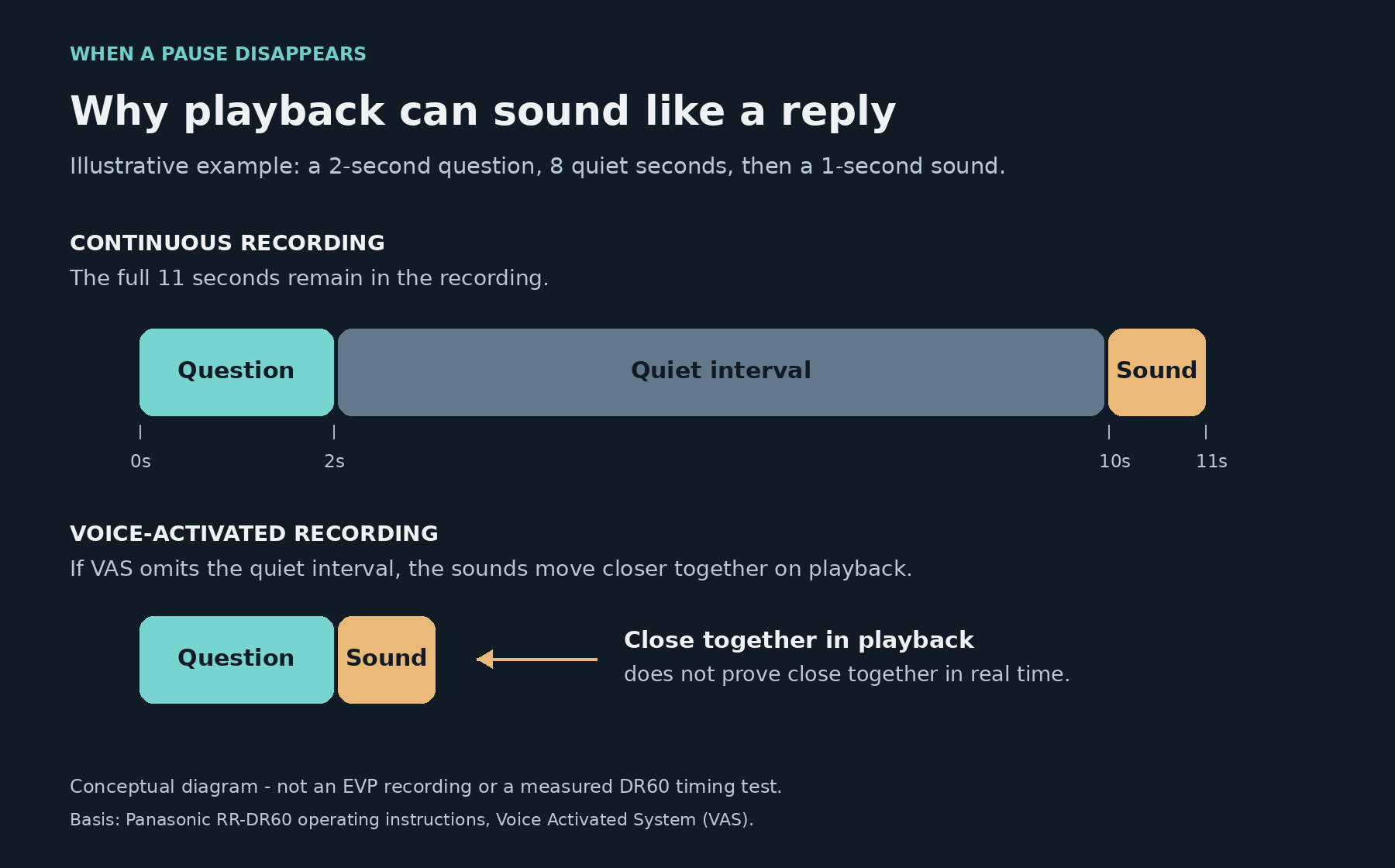
Continuous recording provides a better way to check whether an apparent answer actually followed a question immediately.
What first-hand testing found—and what remains a theory
John Costella initially proposed corrupted memory as an explanation for unexpected DR60 playback sounds. His Halloween 2022 update reported that resetting did not eliminate them. Unexpected sounds appeared on only one of two adjacent DR60s, while room sounds appeared on both; sustained conversation keeping voice activation engaged produced no apparent EVP in that stretch.[10]
He consequently proposed a VAS software fault in assembling compressed audio. This remains a hypothesis, not an established defect or measured false-positive rate. Different microphone responses and settings also require consideration when comparing recorders.
Does low-quality recording explain the voices?
Low fidelity can make sounds harder to identify, leaving more room for interpretation. One relevant mechanism is aliasing: insufficiently filtered high-frequency signals can appear at lower frequencies when digitally sampled. This is a standard recording principle, explained in Analog Devices' technical guidance.[11]
Costella detected aliasing but did not find it sufficient to explain all the unexpected sounds; his DR60 did not respond to his ultrasonic test signals.[10] Aliasing does not turn a sound into a verified message.
The careful conclusion is that the DR60 has documented failure modes and requires equipment controls. Its reputation for producing “more voices” cannot, by itself, establish that it is detecting more spirits.
Can enhancing a recording create another problem?
Noise reduction is useful, but an enhanced recording is a processed version of the evidence. Audacity's own documentation warns that noise reduction can introduce distortion and short tonal artefacts sometimes described as musical noise.[12]
That does not mean every cleaned-up EVP is manufactured. It means listeners should be able to compare the processed clip with the untouched recording. A sound that becomes voice-like only after processing needs particular scrutiny.
There are several distinct things to check: an ordinary voice with an unidentified source, ambiguous noise interpreted as speech, a recording fault, or an artefact introduced during editing. Those mechanisms should be tested separately rather than bundled into a single explanation for every case.
Before you read the caption
Our suggested approach to an EVP clip is straightforward:
- Listen before reading the proposed words.
- Write down what you hear, allowing for the answer “no clear words”.
- Ask another listener to do the same independently.
- Request the original recording and surrounding audio, plus a clear record of any processing.
- Check the recorder model, sensitivity, playback speed and voice-activation settings.
- For a DR60 claim, compare simultaneous continuous recordings from an independent recorder and note which sounds appear on each.
- Compare sessions in an ordinary control location; a supposedly haunted venue should not be the only place the equipment is tested.
- Preserve recordings before any reset or other test that would erase them.
- Keep your interpretation separate from claims about the sound's source.
This is a way to examine a claim more fairly, rather than a test that can certify a ghost.
The fascination survives that scrutiny. A sound that seems almost—but not quite—human can still be deeply eerie.
But before asking who is speaking, there is a quieter question to answer:
What did you hear before somebody told you what it said?
Sources
[1] Imants Barušs (2001), Failure to Replicate Electronic Voice Phenomenon, Journal of Scientific Exploration, 15(3), 355–367. Full paper. Historical claims above are attributed to the paper's review; the recording experiment is the author's own research.
[2] Michael A. Nees and Charlotte Phillips (2015; first published online 2014), Auditory Pareidolia: Effects of Contextual Priming on Perceptions of Purportedly Paranormal and Ambiguous Auditory Stimuli, Applied Cognitive Psychology, 29, 129–134. Publisher abstract.
[3] Jess M. Williams and Mark Blagrove (2022), Paranormal experiences, sensory-processing sensitivity, and the priming of pareidolia, PLOS ONE, 17(9), e0274595. Full paper.
[4] San Diego Paranormal Research Society, Audio Data. Investigator archive. Source for the attributed Queen Mary claims, not independent confirmation of spirits.
[5] Ghost Research Society, Queen Mary Investigation, 25 April 2024. Investigator report. Includes the editor's observation about the “Try me” clip.
[6] Society for Psychical Research, Enfield Poltergeist, Psi Encyclopedia. Case account. Source for the recorded-voice distinction and reported phonation tests; interpretations remain disputed.
[7] Kenny Biddle (2023), The Holy Grail of EVP – Panasonic DR60. Investigator introduction and demonstration. The accessible page introduces a video; no unviewed demonstration results are asserted here.
[8] Panasonic, RR-DR60 Service Manual, troubleshooting section 3.3, Memory mode. Scanned manufacturer manual. The fault descriptions are manufacturer documentation. The cropped illustration uses the manual excerpt reproduced by John Costella.
[9] Panasonic, RR-DR60 Operating Instructions, Recording / VAS. Manufacturer instructions reproduced by Manualzz.
[10] John Costella (2022, with later site notes), Hearing ghosts? EVP and the DR60, including the Halloween 2022 update. First-hand investigation. Findings and hypotheses are attributed; the later update changes the initial explanation.
[11] Analog Devices, Filter Basics: Anti-Aliasing. Technical guidance.
[12] Audacity, Noise Reduction. Official manual.