I. The encounter
Before the house had a famous name
Before there was a film, there was a family trying to make a home.
The name The Conjuring House comes with instructions for the imagination. We expect a threat. We examine a doorway for a silhouette and a wardrobe for whatever might be waiting on top. Even an empty room arrives already occupied by something we have seen on a screen.
Try, for a moment, to take that name away.
Leave the building. Leave the rooms. Leave a kitchen that must accommodate seven people, possessions that need a place, and the daily business of living together. A family does not move into a soundtrack. It moves into somewhere that must become ordinary.
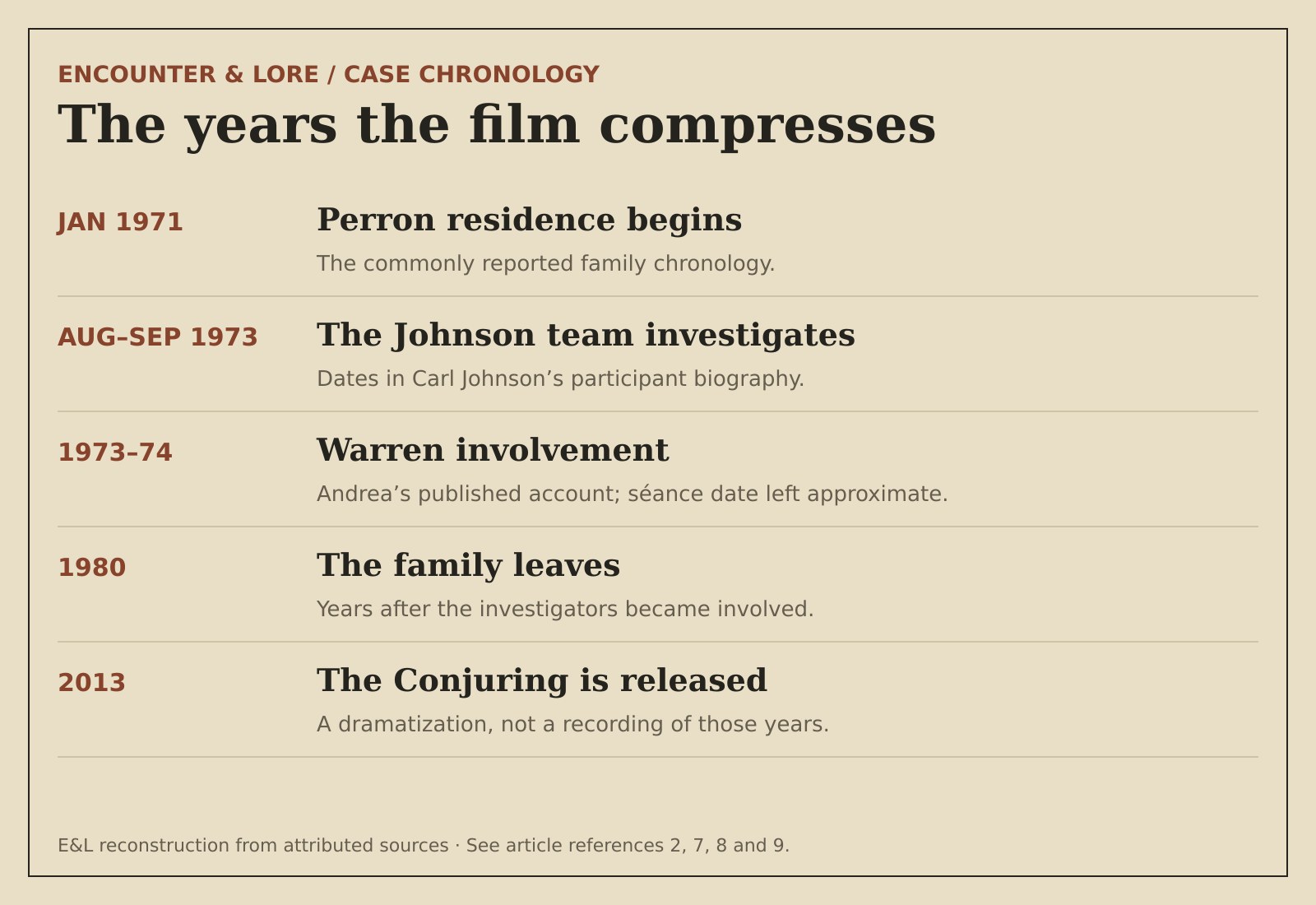
Roger and Carolyn Perron brought their five daughters—Andrea, Nancy, Christine, Cindy and April—to a farmhouse in the Harrisville area of Burrillville, Rhode Island, in January 1971. Their residence would last until 1980. The broad chronology is much firmer than the supernatural explanation subsequently attached to it. [1, 2]
There would be school days, meals, arguments, practical problems and memories which did not belong to a horror story. That distinction will matter. A decade cannot be understood only through its most frightening moments.
But in Andrea’s later telling, the unfamiliar was present almost immediately.
She recalled a man on moving day whom several sisters reportedly saw, then believed had disappeared. [3]
Imagine the smallness of that first question. Who is he? In a busy house, an unfamiliar adult need not be alarming. Someone knows him. Someone will explain.
Only afterwards does the question change.
Not who he was.
Whether anyone else was supposed to be there at all.
That is the disturbing threshold of the Perron story: an ordinary encounter reinterpreted as an encounter with the dead. Whether that interpretation was correct is a separate question. For the people telling it, the house had already become less easily explained.
A disturbance in the ordinary
The Warren organisation’s present-day account describes a household troubled by small dislocations: a broom apparently changing position, a scraping sound near a kettle, and dirt appearing on a recently cleaned floor. Its account also describes apparitions of differing temperaments, unpleasant odours and experiences associated with the cellar. These are reported events, not independently verified findings. [1]
There is a particular intimacy to that kind of story.
A threat outside can be given a boundary. Shut the door. Come inside. Put the familiar things between yourself and the dark.
Here, the familiar things are the story.
A broom. A floor. The next room.
The unsettling possibility is not simply that something has entered the home. It is that someone else behaves as though the home was theirs already.
That impression helps explain the emotional force of the account without establishing its cause. It also explains why the smallest incident can become significant once several incidents have acquired a common interpretation. The broom is no longer merely misplaced. It belongs to a pattern.
In a later interview, Andrea described Cindy coming to her frightened by voices which she said repeated a message about seven dead soldiers in a wall. Andrea’s recollection of her sister’s report is not a recording of the voices, nor evidence that bodies were present. [4]
The distinction does not make the scene emotionally empty. A frightened child seeking her sister is a human event before it becomes a paranormal claim.
But we must keep the levels separate: what Cindy reportedly experienced; what Andrea remembers being told; and what someone later concluded about the property. They are connected statements, not interchangeable pieces of proof.
The strongest cinematic version allows the fear to remain while refusing to supply a supernatural camera angle. We do not cut to soldiers inside the masonry. We stay with the uncertainty outside it.
Different people, different houses
Seven members of a family can inhabit the same address without inhabiting the same experience.
A child may find an encounter intriguing which a parent finds threatening. Someone elsewhere in the house may hear nothing. A practical explanation may reassure one person and feel dismissive to another. Over time, the disagreement itself can become part of what makes a home difficult.
Joe Nickell’s reading of the memoir stresses Roger’s initial scepticism and the alignment of Carolyn and the daughters in their interpretation of events. That is a critic’s analysis of published recollections, not permission for us to diagnose the family or invent private motives. [5]
A haunting account can become an argument about credibility as well as an argument about ghosts. If someone says they are frightened, an answer about a loose latch may address the door while seeming not to address the person. Conversely, accepting the fear does not oblige anyone to accept the explanation attached to it.
What would reassurance look like inside a household where its members no longer agreed about what was happening?
Andrea’s relationship with the farmhouse also resists a simple narrative of unrelieved terror. In 2022 she described wanting to return, while Carolyn refused to go back. [6]
A person can treasure a childhood setting and remember frightening events there. Another person can remember the same place primarily as somewhere to escape. Neither response, by itself, verifies or disproves a haunting.
The title of Andrea’s memoir, House of Darkness House of Light, preserves that duality. A house can hold a family’s happiest memories and its worst without becoming a contradiction.
The investigators arrive
In the family’s chronology, the experiences precede the Warrens. Their arrival introduced a new framework for interpreting them.
Carl Johnson’s own professional biography places him and his twin brother Keith, working with a Rhode Island College investigation group, at the Perron case in August and September 1973. It says they alerted Ed and Lorraine Warren. That intermediate team deserves a place in the chronology. [7]
Andrea places the Warrens’ first appearance around Halloween 1973; her 2024 interview is not fully consistent about which side of Halloween. The approximate date is retained here; a precise night is not established. [4]
The emotional appeal of an investigator is easy to understand. Someone arrives who has heard accounts like yours before. The events have names. There is a framework. Perhaps there is a way to make them stop.
But a framework does more than organise evidence. It influences what the next experience will mean.
A noise may become a warning. A smell may become a sign. An event once described as strange can be reclassified as hostile. Once a presence has a name, otherwise disconnected experiences can begin to look like the actions of one character.
In this case, the name most audiences remember is Bathsheba.
We will return to the woman behind it. First, the night which most sharply separates the family’s account from the film.
The séance
At this point, the story becomes both more dramatic and harder to examine.
A séance is an attempt at communication. An exorcism is an attempt to expel a possessing or oppressive entity through a religious rite. Accounts which substitute one word for the other change what the participants were allegedly trying to do.
Andrea’s 2022 account describes a séance attended by the Warrens and others, during which Carolyn spoke strangely, rose with her chair and was thrown. Andrea calls it an attack, not possession. She says cameras were destroyed and the audio was white noise. These are retrospective claims, including the claimed failure of documentation. [6]
Let the room remain unfilmed.
No impossible shot from above. No view through the eyes of whatever the storytellers believed was present. No borrowed scream from a film, quietly passed off as a historical sound.
There is a daughter’s account of seeing her mother in danger. There are people gathered to intervene. There is the claim of something extraordinary happening in front of them.
And there is an evidential gap where the audience most wants the recording to begin.
The Warren organisation’s current summary calls Carolyn possessed and says Roger ordered the Warrens out afterwards. It therefore does not support a simple historical account in which a successful Warren rescue ends the ordeal. [1]
Whatever happened in that room, the question for the family was not merely whether the intervention had identified a spirit. It was whether the people who had come to help had made things safer.
For a film audience, the most satisfying answer is a decisive victory.
For an investigator, the satisfying answer is not necessarily the available one.
After the visitors leave
Andrea’s published letter to Horror-Movies.ca places the Warrens’ investigation in 1973–74. Her account does not make them permanent fixtures in the household. [8]
The family’s residence continued until 1980. [2]
That interval is one of the most important facts in the case. An investigator’s visit and the end of a family’s time in a house are not the same event. To place the credits immediately after an intervention is to create a relationship between action and outcome which the longer chronology does not establish.
The story does not become less compelling when we restore that time. It becomes less conveniently shaped.
There is no single night which allows us to close every door.
II. The film: what changes when the Warrens become the centre
James Wan’s The Conjuring was released in 2013, written by Chad and Carey W. Hayes. It is a feature film, not an observational record of the Perron home. [9]
Its central transformation is structural. The audience follows investigators who can recognise the threat, explain its history and act against it. The camera also confirms things which a historical investigator could only hear someone describe.
That difference is larger than whether a particular door slammed.
A comparison to keep beside the film
The movie descriptions below refer to the 2013 film’s story, with its published dialogue transcript used as a cross-check. Family-account columns describe published claims, not a certified alternative history. [10]
| Element | The film’s version | The reported case and evidential distinction |
|---|---|---|
| Investigation date | Ed records an interview dated November 1971. | Carl Johnson places the earlier team’s work in 1973; Andrea dates Warren involvement to 1973–74. [7, 8] |
| Route to help | Carolyn seeks out the Warrens. | The Johnson brothers’ investigation preceded them. [7] |
| Bathsheba | A Satanic mother who kills her child and hangs herself. | No substantiated historical record establishes that biography; the burial record places her death in 1885. [11, 12] |
| The clock | Repeated 3:07 stoppages connect events to the villain’s death. | A screen mechanism; no authenticated contemporary clock log was available for this feature. |
| April’s companion | A boy called Rory. | Memoir accounts reviewed by Nickell identify her companion as Oliver. [5] |
| The final crisis | Carolyn is possessed and threatens her children. | Andrea’s later account calls the séance episode an attack. Do not import the film’s attempted child-killing into the family history. [6] |
| The intervention | Ed performs an emergency exorcism. | Published case accounts describe a séance and Roger expelling the visitors. [1, 6] |
| The ending | The immediate threat is defeated. | The Perrons remained for years after Warren involvement. [2, 8] |
| Annabelle | A separate case frames the investigators’ world. | It is not an object from the Perron household. [13] |
| The film house | A carefully staged cinematic environment. | The production used North Carolina locations/sets, not the real farmhouse as its central filming location. [13] |
The familiar clapping-game sequence is an especially effective piece of filmmaking: an invitation to play becomes a way for an unseen presence to answer. A report from the film’s WonderCon presentation describes how the scene was staged for suspense. That establishes a scene in a movie, not an authenticated corresponding incident in 1970s Rhode Island. [14]
What the camera gives us
Consider the difference between two statements.
Someone tells an investigator that a figure stood behind a door.
A film shows us the figure behind the door.
The first leaves questions about lighting, viewpoint, duration, interpretation and memory. The second can resolve all of those questions inside its fictional world. We know what was there because the director allows us to see it.
When the film is sold through a real case, that cinematic certainty can travel backwards. An image created for the audience starts to feel like information recovered from the house.
That journey needs a pause. A scene may be inspired by testimony without reproducing it. A character may bear a real person’s name without telling their history. A dramatic ending may express a filmmaker’s purpose without documenting an outcome.
Andrea’s own assessments are not identical
In her published letter associated with the film’s original release, Andrea praised its treatment of the family’s experiences, distinguished it from a direct adaptation of her books, and emphasised the Warren perspective. [8]
By 2021 she described it as approximately 95 per cent fiction. [15]
Those assessments differ, and both belong in the record. The percentage is an interviewee’s appraisal, not the result of a scene-by-scene measurement.
It is possible to value a film’s emotional impact while rejecting its literal accuracy. It is also possible for a person’s public assessment to change. Neither possibility allows us to supply their private explanation without asking them.
What we can assess is the work in front of us: the film places explanatory authority and dramatic resolution with the Warrens. The family’s longer story does not settle so neatly around them.
III. The Perrons and the Warrens: agreement, conflict and authority
Calling this simply “the Perrons versus the Warrens” would promise a clean divide that the sources do not provide.
Both the family’s prominent spokesperson and the Warren organisation affirm a supernatural interpretation. They are not debating from opposite sides of a believer–sceptic boundary. Their disagreements concern identification, language, intervention and who gets to tell the experience.
The important disagreements
| Question | Position or claim in the published material | What we can responsibly say |
|---|---|---|
| Was Carolyn possessed? | The present NESPR page says yes; Andrea’s 2022 interview says she was attacked. [1, 6] | The accounts disagree. Neither label constitutes a demonstrated mechanism. |
| Did the visit help? | The family account describes a frightening séance and the visitors being ordered out. [1, 6] | Do not substitute the film’s successful resolution for that account. |
| How was Bathsheba identified? | Andrea’s later interview credits Lorraine’s initial perception; Biddle’s examination of memoir passages describes Carolyn supplying research and the needle story. [4, 16] | The sequence of information transfer is disputed and matters to any claim of psychic identification. |
| Were the Perrons without religious faith? | Andrea rejects that implication and describes a Catholic family background. [4] | Do not write that the family needed the investigators to introduce them to religion. |
| Were the Warrens deliberately malicious? | Andrea has also said she believed they intended to help. [6] | Criticism of an intervention is not proof of malicious intent. |
These are not all independent witness records. The NESPR page is a present-day organisational account, and it quotes Andrea itself. It is useful for showing what the organisation currently publishes. It is not a signed statement by Ed or Lorraine made during the investigation, nor an independent corroboration merely because it appears on a different website.
The notebook question
Andrea alleges that Lorraine borrowed Carolyn’s notebook, containing descriptions, sketches and research, and did not return it. [4]
A notebook made near the events could be important. It might help establish what was recorded before later interviews, which historical claims were already circulating, and which descriptions preceded the investigators’ interpretations.
But “could” is doing necessary work here. The notebook was not available for examination for this feature. Its contents, completeness, dating, custody and present location have not been independently established in this research.
Andrea’s allegation remains hers; the available material does not establish theft, a sale, a deliberate cover-up or what the missing pages would prove. A missing source creates a limitation. It cannot be filled with whichever conclusion either side prefers.
Intention is not the same as competence
Our central question is narrower and more useful than whether the investigators were heroes or villains.
What did they know before arriving? How did they separate the family’s observations from their own beliefs? What checks preceded the séance? What did they promise? What was recorded? What changed afterwards?
Those questions apply even if everyone involved was sincere.
A reassuring manner does not validate a diagnosis. Equally, a frightening outcome described by a participant does not establish that the investigator caused it through supernatural means. We need the sequence, the documentation and alternatives that can actually be examined.
We also need to avoid inventing a rebuttal. Where this research has no direct response from the Warrens to a specific allegation, the honest statement is that the response is not in the material reviewed.
IV. Bathsheba: the woman behind the borrowed face
A ghost story can make a name famous while leaving the person behind it almost entirely unknown.
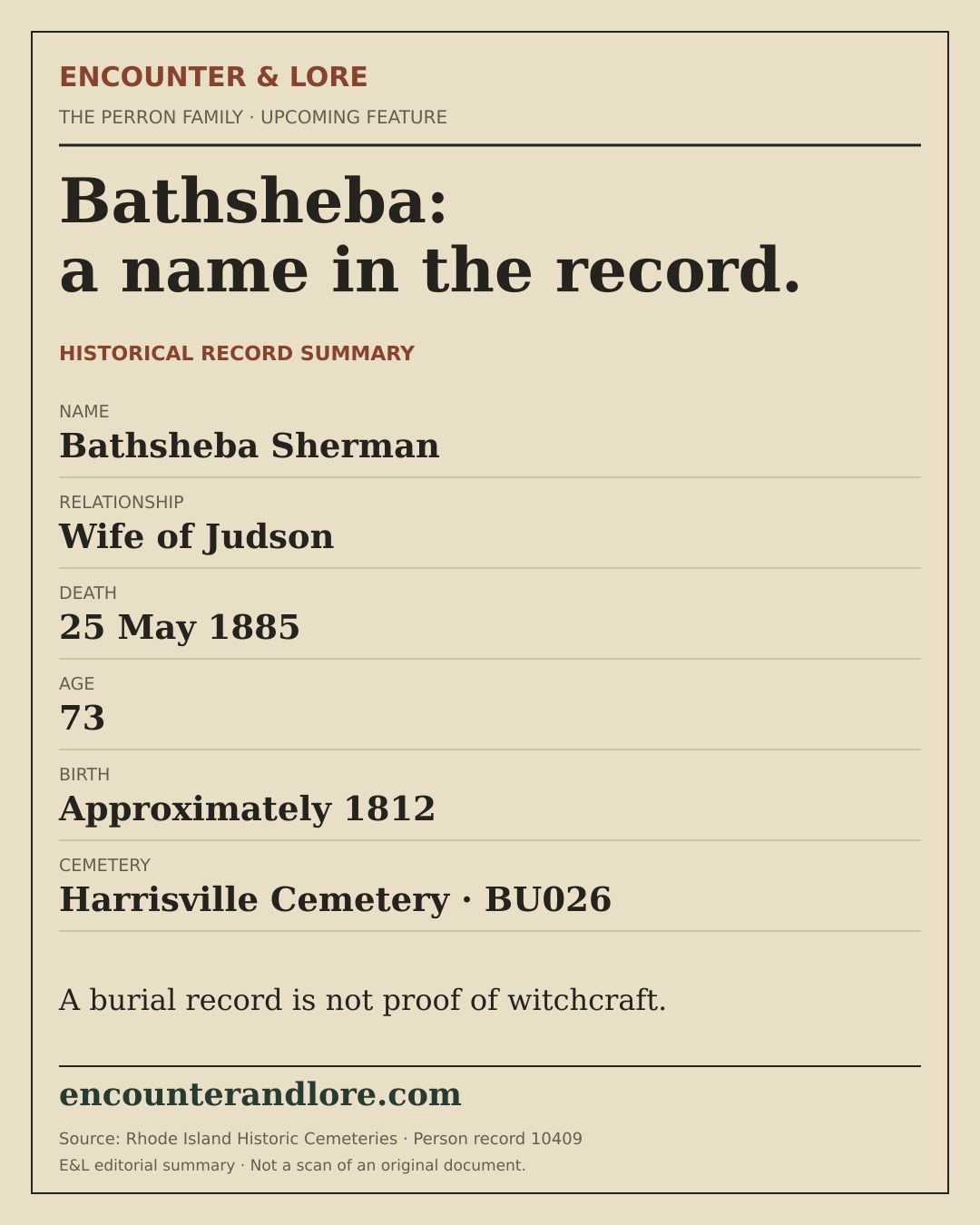
The Rhode Island Historic Cemeteries database lists Bathsheba Sherman, wife of Judson, at Harrisville Cemetery. It records her death on 25 May 1885, aged 73, with an approximate birth year of 1812. That is a record we can inspect. It does not tell us she was a witch. [11]
Historical researcher J’aime Rubio identifies her as Bathsheba Thayer and places her married life at the neighbouring Sherman farm, not as the resident mistress of the Perron house. Rubio reports finding no documentary basis for the murder and witchcraft allegations attached to her. [12]
Nickell cites town records and an 1885 obituary describing paralysis at her death. Interpreting that historical terminology as probably a stroke is reasonable; treating it as a retrospective clinical diagnosis is not. It contradicts the film’s hanging narrative without requiring us to invent another medical certainty. [17]
Several historical researchers have failed to locate the supposed infant-murder inquest. That does not allow us to prove that every relevant record has survived or every archive has been searched perfectly. It does mean we lack the documentary foundation needed to publish the accusation as a fact.
The distinction is substantial: a real person existed does not establish the horror character’s biography happened.
The danger of transferring another person’s history
Biddle traces a reported Arnold hanging to Susan Arnold, about fifty, at another home, rather than the farmhouse’s elderly woman of popular retellings. He cites an obituary and location records. [16]
Repairing Bathsheba’s reputation does not justify moving the villain role onto Susan.
A documented death is not evidence of posthumous hostility. Sharing a surname is not proof of residence at a particular address. Even establishing that someone died in a building would not establish that they haunted it.
There are several separate propositions here, and the most famous versions of this story hurry across the gaps between them.
- A historical person lived.
- A death or alleged crime occurred.
- It happened on this property.
- An apparition appeared there later.
- The apparition was that person.
- That person caused every subsequent disturbance.
Each step needs support. Confirmation of the first does not carry the other five with it.
A face in an old photograph
A vintage farmhouse photograph has been used in connection with Bathsheba. History vs Hollywood notes that the woman singled out in it has not been demonstrated to be her. [13]
The evidential lesson is simple. A photograph can be authentic while its caption is wrong. A real face does not become an identified face because a video zooms in at the appropriate moment.
An archival image needs a traceable origin and a defensible caption. This woman cannot responsibly be presented as “the real Bathsheba”; an illustration of the film’s antagonist is not a historical portrait.
The uncertainty is part of the story. It is more revealing than another invented likeness.
V. The evidence: what can actually bear weight?
The case contains several kinds of material. Giving them the same label—“evidence”—can conceal more than it explains.
The following is our assessment of what the reviewed public record can support. It is not a claim that every surviving archive has been inspected.
1. The existence of a real family and a real home
These supply the historical setting. They distinguish the case from a story invented without living participants.
They do not establish the cause of any disturbance. A real setting and named witnesses make a claim investigable, not automatically true.
2. Testimony: valuable, but not a recording of the room
Andrea is a participant and family member, not merely a commentator. Her accounts deserve accurate attribution. But an interview contains a mixture of her own memories, reports from relatives, later interpretations and historical information acquired elsewhere.
Those components must be separated before asking how strong the testimony is.
For each incident, we should ask: Did she see it? Did someone describe it to her that day? Was she recounting something she later read? Had a supernatural explanation already been suggested?
A person’s confidence answers how firmly they hold a memory. It does not, on its own, answer those other questions.
Multiple family members may strengthen an account, especially where their descriptions were independently recorded before discussion. But one person saying that several relatives agreed is not equivalent to possessing separate contemporaneous statements from those relatives.
That distinction respects testimony by examining what it actually consists of.
3. The séance: the largest claim and the largest gap
If a chair and its occupant rose and travelled across a room without ordinary physical support, that would be an extraordinary event. The issue is not whether it would matter. The issue is what record allows us to establish that it happened that way.
We would want continuous footage showing the chair, floor and participants, original sound, clear sightlines, a reliable timeline and independently collected accounts. We would want to know whether any observer saw the whole movement rather than its beginning or aftermath.
The public materials reviewed for this feature do not supply that standard of documentation.
An account of equipment failure may explain why someone says a recording is absent. It cannot replace the absent recording. If malfunction is itself described as supernatural, it becomes an additional claim needing examination, not a guarantee that the main event occurred.
The responsible verdict is that the reported event remains unverified, not that its size makes verification unnecessary.
4. Interview tapes: the difference between fear and its cause
A production-history account describes Ed playing producer Tony DeRosa-Grund a recording of an interview with Carolyn. [13]
That is important because saying “there were no recordings” would be too broad. But a recorded interview and a recording of an unexplained physical event are different objects.
A tape might preserve a speaker’s voice, wording and distress. Without a complete original and reliable dating, even its context requires caution. However moving the testimony, the tape would not automatically identify the cause of the fear being described.
Assessing that tape would require the complete recording, its provenance and any accompanying notes. An edited promotional extract should not quietly become a controlled observation.
5. Documentary history: where specific claims can be checked
The historical part of this case is unusually useful because at least some propositions have an answer independent of anyone’s paranormal beliefs.
Where was a person living? What did a contemporary obituary say? Which parcel of land is being discussed? Are two similarly named people actually the same person?
When a proposed historical identity fails, that weakens the explanation built upon it. It does not retrospectively prove that a witness never saw anything strange. The observation and the identification are different claims.
Conversely, correcting a surname or address does not validate the remaining supernatural claim. It removes one mistake; it does not reveal a demon underneath it.
6. Later owners and later investigations
Biddle reports that former owner Norma Sutcliffe did not share the demonic interpretation and distinguished minor noises or movement from the Perrons’ account. [16]
Different occupants can provide useful comparisons. But there is an important limit in both directions.
A quiet later household does not prove that no earlier disturbance occurred. A dramatic modern recording does not verify an event decades earlier. The building may be the same while occupants, equipment, condition, expectations and experimental controls differ.
Every later recording needs a date and a named source. An EVP captured long after the Perrons left is evidence of what that later recording contains. It is not an audio window into their childhood.
7. Claims which become more testable when made smaller
Nickell’s 2016 visit with Sutcliffe produced specific mundane suggestions: an imperfect cellar-door latch, a latch which could catch when an attic door closed, old window reflections, and cluster flies rather than inexplicable winter insects. These are explanations he proposed from a later inspection and account analysis, not experiments conducted during every Perron incident. [17]
The strength of such suggestions is their specificity. We can examine a latch. We can test whether walking nearby releases it. We can compare a reflection from different angles.
Their limitation is retrospective reach. Repairing or examining a door decades later cannot prove exactly what occurred on a particular earlier night.
The useful conclusion is therefore precise: a door’s unexpected movement does not require an invisible agent merely because the observer did not immediately identify a mechanical cause.
One repaired door also cannot explain every voice, apparition or séance report. A good investigation allows different incidents to have different causes.
8. Sleep experiences and suggestion: explanations to examine, not labels to apply
The NHS describes sleep paralysis as an inability to move or speak around falling asleep or waking, sometimes accompanied by a sensed presence or pressure. That makes sleep-related mechanisms relevant to accounts involving immobility near sleep. It does not establish a diagnosis for Carolyn, or explain reports made while people were fully awake. [18]
Nickell argued that some memoir incidents fit waking dreams and sleep paralysis; he also suspected pranking and suggestion. His confidence should not be mistaken for direct observation of those causes in the 1970s. [5]
There is research which helps us ask better questions. In the 2009 “Haunt” experiment, French and colleagues exposed 79 participants to combinations of infrasound and electromagnetic fields, or neither. Many reported unusual sensations, but their frequency did not track the experimental condition. The authors considered suggestibility the most economical explanation of their findings. [19]
This does not demonstrate what happened to the Perrons. It also does not support the easy claim that “infrasound explains haunted houses”. It shows why felt experiences alone cannot identify the mechanism producing them.
We have no case-specific environmental measurements from the Perron years in this research. We should not announce that carbon monoxide, mould, magnetic fields or infrasound solved the case without those measurements.
9. Motive is not a shortcut
A memoir, a film contract or a commercial investigation can create incentives. That matters when assessing publicity, selection and access to material.
It does not demonstrate that an original witness lied.
Likewise, distress and sincerity do not establish that an interpretation is correct. A person can be frightened and mistaken, sincere and selective, or accurate about an observation while wrong about its cause.
The most persuasive analysis explains a particular piece of evidence. It does not substitute a theory about someone’s character for the work of examining it.
VI. What remains when the credits stop
The narrow conclusion is stronger than an inflated one.
There was a family. There was a farmhouse. There were reports of experiences the family understood as encounters with spirits. There were investigators who became part of that account. There was a film which made the investigators’ interpretation visible, dramatic and internationally recognisable.
The reviewed public material does not establish a paranormal cause. Nor does it allow us to reconstruct and solve every reported event individually.
Some historical claims have much clearer answers: Bathsheba’s burial record is not the film’s biography; a neighbouring person’s death is not automatically part of the farmhouse’s history; and a present-day organisational summary is not a contemporaneous case file.
The deepest difference between the movie and this case may be what each allows its audience to know.
The film gives us an adversary, a confrontation and an answer.
The archive gives us claims, disagreements and missing material.
And the family gives us something harder to fit into either: a place remembered with affection by one person and dread by another, an intervention remembered as dangerous, and a childhood which did not become unreal simply because its explanation remains uncertain.
We can leave room for the human story without granting certainty to the haunting.
Picture the building again, this time without the film’s name laid over it.
The rooms have not changed simply because we have stopped supplying the monster.
The questions are still there.
And perhaps the one most worth taking into the next room is not whether we can make this story frightening.
It is whether we can tell it without making the evidence say more than it does.
Sources and source character
Sources were consulted for this feature on 3 November 2026. An interview is primary evidence of what its speaker says, not automatic confirmation of the events described. Quoted or paraphrased memoir passages encountered in criticism are identified as such; they have not been presented as a complete reading of the books.
- NESPR, “Perron Family Haunting.” Current account published by the Warren organisation. Useful for its wording, including possession, séance and Roger’s reaction; its historical assertions are not treated as independent verification. https://warrens.net/perron-family-haunting/
- Kevin Lang, “The Conjuring: History vs. Hollywood” (2013). A secondary comparison with residence chronology and production-history material. Some historical claims on the page are contradicted by later research; those portions are not adopted. https://www.historyvshollywood.com/reelfaces/conjuring.php
- CBS News, “‘The Conjuring’: How true is the haunted house movie?” (2013). Andrea’s televised account of the moving-day figure. https://www.cbsnews.com/news/the-conjuring-how-true-is-the-haunted-house-movie/
- Michelle Swope, interview with Andrea Perron, Bloody Disgusting (12 April 2024). First-person retrospective testimony; also contains unverified historical claims. Used for the voices report, approximate arrival date, notebook allegation and faith/background discussion. https://bloody-disgusting.com/interviews/3808398/be-not-afraid-andrea-perron-shares-the-chilling-true-story-behind-the-conjuring-interview/
- Joe Nickell, “The Conjuring: Ghosts? Poltergeist? Demons?” Skeptical Inquirer (March/April 2014). Critical reading of memoir accounts. His hypotheses and character assessments are not treated as demonstrated diagnoses or findings about individual incidents. https://skepticalinquirer.org/2014/03/the-conjuring-ghosts-poltergeist-demons/
- Freesat, Andrea Perron interview (19 August 2022). Retrospective testimony; the surrounding promotional prose is distinct from her own words. https://www.freesat.co.uk/news/documentaries/real-conjuring-andrea-perron
- Carl L. Johnson, Demonology, Incorporated author biography. Participant’s retrospective account placing the Johnson team’s involvement in August/September 1973. https://demonologyinc.wixsite.com/home/cv
- Andrea Perron’s published letter, Horror-Movies.ca, “Exclusive: Family Member Reveals The Conjuring ‘True Story’.” Original-release-era statement supporting the film while identifying its Warren perspective and 1973–74 investigation. The current page’s search date should not be mistaken for the letter’s original context. https://www.horror-movies.ca/exclusive-family-member-reveals-the-conjuring-true-story/
- American Film Institute Catalog, The Conjuring (2013). Film identification and writing/directing credits. https://catalog.afi.com/Film/69558-THE-CONJURING
- The Conjuring (2013), film; dialogue transcript hosted by Springfield! Springfield! Transcript used for narrative cross-checking, not a certified shooting script or primary evidence of the haunting. Film descriptions are cross-checked against the transcript; it is not a certified shooting script. https://www.springfieldspringfield.co.uk/movie_script.php?movie=the-conjuring
- Rhode Island Historic Cemeteries, Bathsheba Sherman, person record 10409. Cemetery transcription: Harrisville Cemetery BU026, death 25 May 1885, age 73, approximate birth 1812. A modern transcription, not the original death certificate. https://rihistoriccemeteries.org/newgravedetails.aspx?ID=10409
- J’aime Rubio, “Bathsheba Sherman’s Vindication.” Historical research discussing census, marriage, death and other records. Underlying historical records are described through the cited researcher where not directly examined. https://deconstructingtheconjuring.blogspot.com/2023/05/bathsheba-shermans-vindication.html
- History vs. Hollywood, production, photograph and Annabelle sections of source 2. Listed separately here to make the relevant sections clear; it remains the same source, not additional corroboration. https://www.historyvshollywood.com/reelfaces/conjuring.php
- ComingSoon, “WonderCon: James Wan’s The Conjuring Panel” (2013). Reporting on the presentation and clapping-game scene. Useful for cinematic technique, not verification of historical events. https://www.comingsoon.net/movies/news/102171-wondercon-james-wans-the-conjuring-panel
- Global News (2021), Andrea Perron interview. https://globalnews.ca/news/8247260/bathsheba-search-for-evil-andrea-perron-interview-the-conjuring/
- Kenny Biddle, “Correcting the Conjuring House History,” Skeptical Inquirer (4 December 2019). Historical investigation citing/reproducing records and memoir passages; used for Susan Arnold, the information-transfer discrepancy and Sutcliffe’s position. https://skepticalinquirer.org/exclusive/correcting-the-conjuring-house-history/
- Joe Nickell, “Dispelling Demons: Detective Work at The Conjuring House.” November/December 2016 print issue; later inspection and archival references. https://skepticalinquirer.org/2017/02/dispelling-demons-detective-work-at-the-conjuring-house/
- NHS, “Sleep paralysis.” General clinical information used to explain a possible category of experience, not diagnose a participant. https://www.nhs.uk/conditions/sleep-paralysis/
- French, Haque, Bunton-Stasyshyn & Davis (2009), “The ‘Haunt’ project: An attempt to build a ‘haunted’ room by manipulating complex electromagnetic fields and infrasound,” Cortex 45(5), 619–629. DOI: 10.1016/j.cortex.2007.10.011. A controlled study unrelated to the Perron property, included for its methodological relevance. Abstract: https://pubmed.ncbi.nlm.nih.gov/18635163/ · Author-hosted paper: https://www.haque.co.uk/work/haunt/HauntProject.pdf