
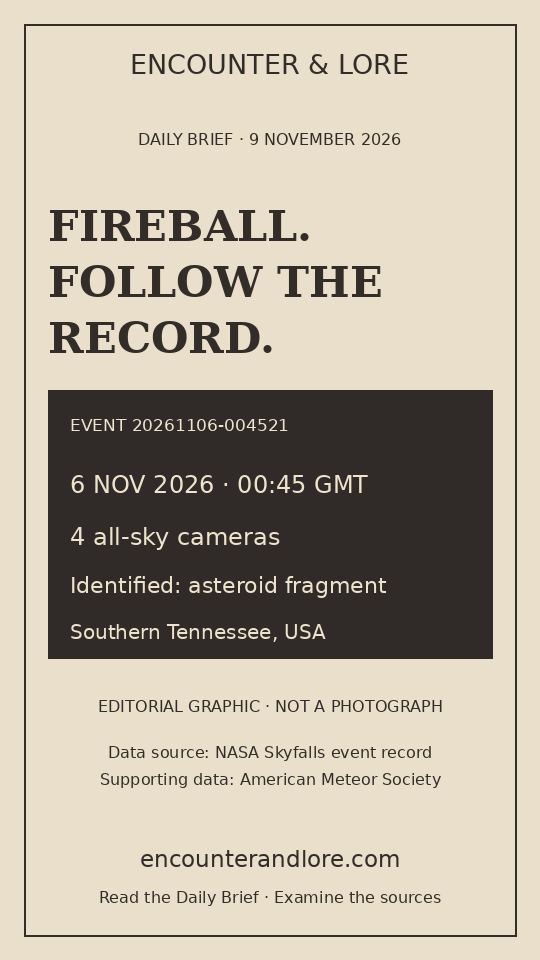
A bright fireball seen over southern Tennessee has an explanation grounded in camera measurements. NASA’s event record identifies it as a small asteroid fragment, detected by four all-sky cameras.
The event occurred at 19:45 EST on 5 November — 00:45 GMT on 6 November. NASA estimates a diameter of about two inches and says it disintegrated roughly 25 miles above East Ridge, Tennessee. Its analysis also excludes the active Taurid meteor shower.
The useful question is how an extraordinary-looking observation becomes an identified event: compare accounts with independent recordings and a measured trajectory before assigning a mysterious origin.
Sources: NASA Skyfalls, event 20261106-004521; NASA database index. Checked 9 November 2026.
Why today: An 8 November report renewed attention; the independently accessible NASA record supports a source-led follow-up. The report’s full page could not be fetched, so witness quotations and its extra descriptive details are excluded.
NASA’s page gives the event time, but no precise publication timestamp. Its camera analysis supports identification as a meteor; individual social-media clips and witness quotations have not been independently authenticated here.