
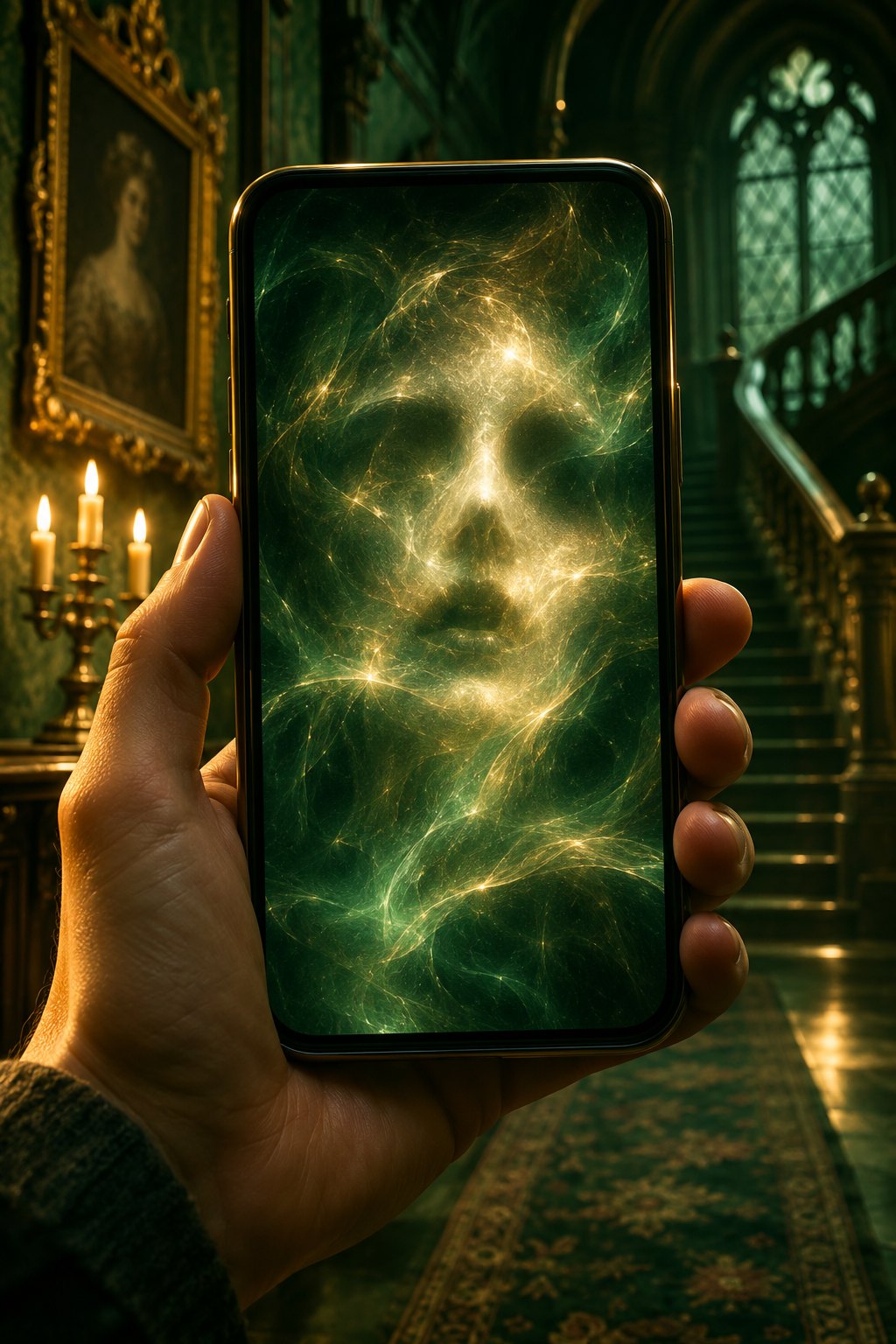
A face appears on a phone in a darkened room. It looks uncannily appropriate to the story you have just heard. Before asking who it might be, there is another question: how did the picture get there?
From a sensor to a picture
GhostTube’s own explanation of SEER describes a chain of processing. Depending on the handset, sensors can register magnetic changes or movement. Certain readings select words from a built-in dictionary; those words are then supplied to an AI system that creates an image. The resulting picture is a generated interpretation, rather than a photograph of whatever caused the reading. [1]
The developer also says that nearby electronics, metal and movement can trigger its tools, and acknowledges that communication with ghosts has not been scientifically demonstrated. Those qualifications matter when a striking image is shared without the steps that produced it. [1]
Why a convincing match needs more than recognition
Our view: the interesting part is the distance between a measurement and the story attached to it. A sensor response, a selected word and an image are different things. Interpreting them as one coherent message adds another step, supplied by the observer.
Imagine a hypothetical result showing an old chair. In a historic building, there may be many rooms, photographs or stories that could make that image feel relevant. A useful test would record the result before searching for a match, keep every unsuccessful result, and compare sessions in ordinary locations as well as reputedly haunted ones.
That would not settle every question about paranormal experiences. It would make it easier to judge whether a pattern is repeatable, rather than selecting the most memorable image afterwards.
The question we would ask
What observation would count against the preferred explanation? A tool becomes more interesting to investigate when its users can describe both a convincing result and a fair way for it to fail.
For another example of technology meeting interpretation, read our feature on EVP and the DR60 recorder.