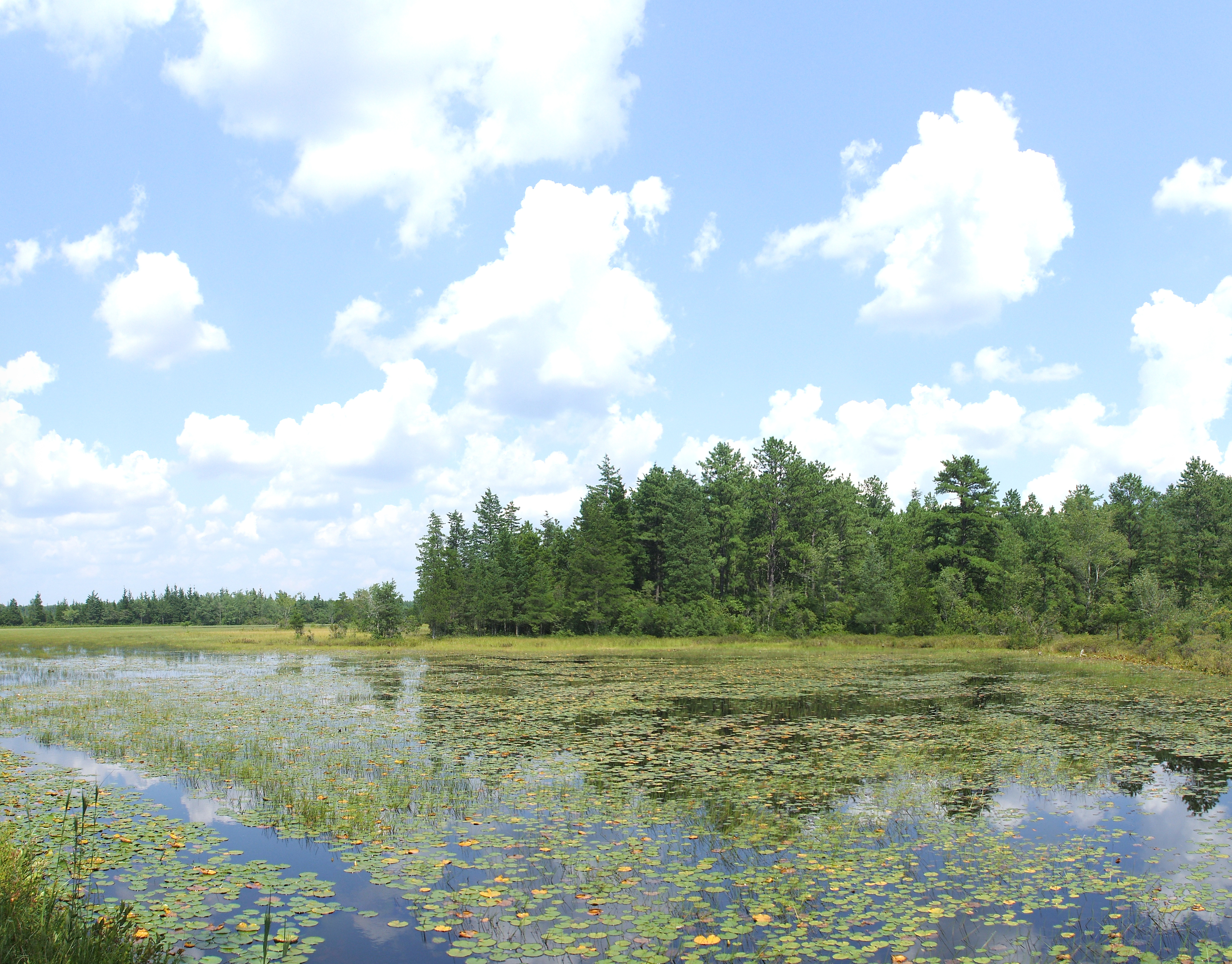
Imagine a sandy road disappearing between the pines. Beyond the trees, water lies dark in the wetlands. Something cries out where you cannot see it.
Give that sound a familiar name, and the woods change.
In New Jersey’s Pine Barrens, that name is the Jersey Devil: the creature said to haunt the forests and swamps, its strange body assembled from features that seem to belong to several different animals. The Pinelands Commission records it as part of the region’s folklore, including stories of its piercing cries. [1]
But following the Devil into the pines means following more than a monster story. It means entering a landscape with a history of its own, and a legend whose beginnings are considerably less straightforward than its most famous telling suggests.
A place with a past
The scale of the setting matters. The Pinelands National Reserve covers approximately 1.1 million acres, spanning parts of seven New Jersey counties. Its sandy terrain includes wetlands and streams whose characteristic tea colour comes from natural organic material leaching through the soil. [2]
Even the name “Pine Barrens” can mislead. The Pinelands Commission explains that the sandy soils retain relatively little moisture and few nutrients, making them difficult ground for the farming settlers expected to practise. “Barren” reflected those agricultural frustrations, rather than an absence of life. [3]
Nor were these woods an empty wilderness awaiting a frightening story. The region was inhabited by Lenape people before European settlement. Later, its resources supported timber cutting, shipbuilding supplies and bog-iron production. Furnaces and forges brought workers and settlements into the forest. [4]
That human history belongs in the picture. A place can look remote while carrying generations of work, displacement, memory and storytelling beneath its trees.
Mother Leeds and the thirteenth child
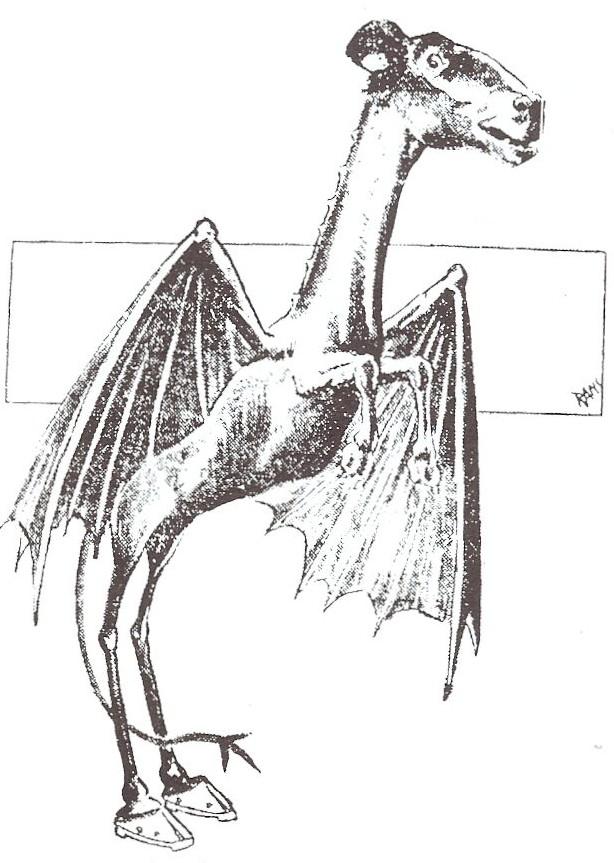
In the familiar legend, a woman known as Mother Leeds is expecting her thirteenth child. Exhausted or distressed, she invokes the Devil. When the child arrives, it becomes a monstrous creature and escapes into the surrounding country. [1]
The details shift with the teller. The New Jersey Historical Society records versions involving a curse, a difficult labour and even a mother who cares for the strange child until her death. There is no single, consistent account. [5]
The creature’s appearance is equally unsettled. Depictions often combine horns, wings and a tail with an animal-like body. [1] The Pinelands Alliance describes a particularly extravagant mixture: a kangaroo-like shape with equine and canine features and bat-like wings. [6]
These are features of the folklore, rather than an established biological description. Their variability is part of what makes the Jersey Devil so compelling: the creature is recognisable, even when no two tellings quite agree on what it is.
The family behind the Devil
The Leeds name provides a route from legend into documented history.
In his 2015 paper, The Jersey Devil: A Political Animal, historian Brian Regal argues that the creature developed from colonial religious and political conflict surrounding the Leeds family. His interpretation challenges the idea that the story began with a literal monstrous birth. [7]
The New Jersey Council for the Humanities outlines the disputes. Daniel Leeds published almanacs containing astrological material that offended members of his Quaker community. He later left that community and published attacks on it. His political associations added further hostility. [8]
What were the almanac wars?
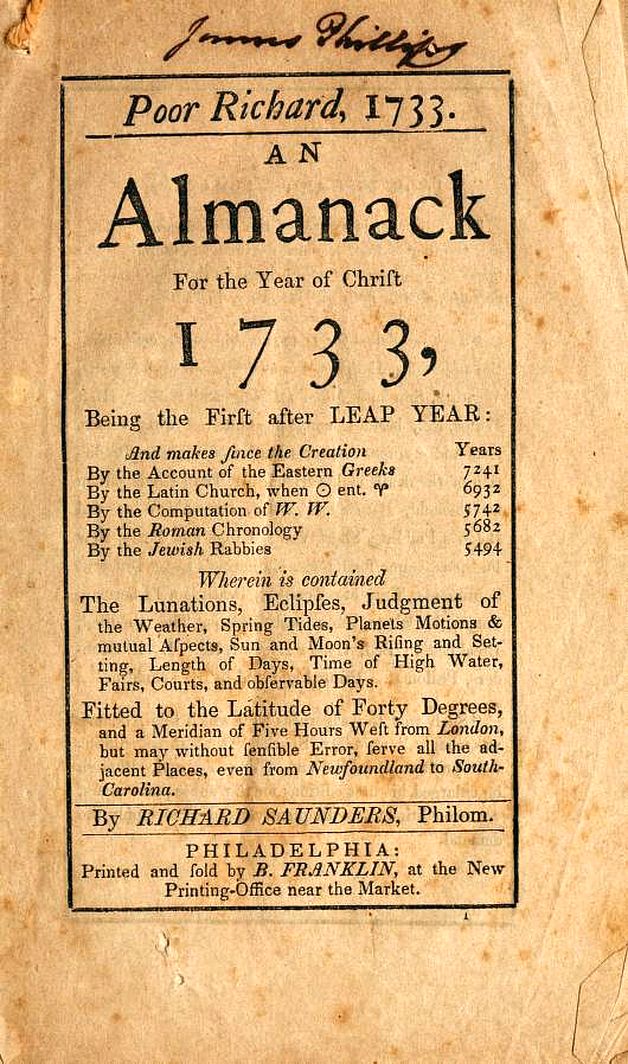
To understand the “almanac wars,” it helps to remember what an almanac was in colonial America. It was not simply a calendar hanging on a wall. Almanacs were among the most widely circulated printed works of the period, combining calendars with weather forecasts, astronomical tables, medical advice, agricultural information, astrological predictions, moral observations and commentary on public affairs. For many readers, an almanac was a practical reference book and a source of entertainment at the same time.
That made almanac publishing commercially valuable and culturally influential. A successful publisher could reach readers across a large region, shape public opinion and build a recognisable public persona. The books were often written in an accessible style, and their mixture of useful information, prediction and humour encouraged readers to return to them year after year.
Daniel Leeds was one of those publishers. His almanacs included astrology and other material that some Quakers considered inappropriate or spiritually dangerous. Quaker communities generally placed strong emphasis on plainness and rejected practices associated with fortune-telling, astrology and elaborate displays of worldly authority. Leeds’s publications therefore created religious tension even before the dispute became a commercial rivalry.
Leeds also became involved in political controversy. He supported positions associated with the colonial establishment and criticised Quaker leaders and their political influence. His opponents could consequently portray him not merely as a publisher with unusual interests, but as someone who had abandoned communal values and aligned himself with hostile political forces. [8]
By the time Benjamin Franklin entered the almanac market, Daniel’s son Titan Leeds was continuing the family business. Franklin’s Poor Richard’s Almanack competed with Titan’s publication for readers and sales. Franklin used satire to mock his rival, predicting Titan’s death and subsequently pretending that the man answering him was a ghost. The target of these jokes was Titan, rather than his father Daniel. [8]
This was not a single argument with a clear beginning and end. It was a repeated process of public characterisation. Each new almanac gave Franklin another opportunity to remind readers of the Leeds image, while the Leeds family’s continued publishing kept the name in circulation. The dispute therefore worked cumulatively: satire repeated often enough could become part of a community’s shared understanding of a person.
Titan’s almanacs also carried a distinctive visual emblem. His publications used a family crest featuring winged, dragon-like wyverns. A wyvern is a heraldic creature resembling a two-legged dragon with wings and a tail. The emblem was not necessarily intended to represent the Devil, but it supplied striking imagery that could be connected to the hostile descriptions already attached to the Leeds name. [8]
The almanac wars thus brought several elements together:
- Religious suspicion: Leeds’s astrology and related material offended some Quakers.
- Political conflict: His alliances and criticisms placed him on the wrong side of existing communal disputes.
- Commercial competition: Franklin and Leeds were rival publishers seeking the same readers.
- Satire and repetition: Franklin’s attacks transformed a business competitor into a comic supernatural antagonist.
- Visual symbolism: The Leeds family’s winged crest offered imagery that could be associated with dragons, devils and other monstrous figures.
Over time, these elements could reinforce one another. A publisher accused of occult interests might be mocked as devilish; a political enemy might be described as morally corrupt; a family crest might be read as evidence of supernatural associations; and repeated jokes might survive after the original dispute had been forgotten.
This does not mean that Franklin invented the Jersey Devil in a single act of satire. Nor does it prove that the Mother Leeds story began as a direct reference to Daniel or Titan Leeds. The evidence does not provide a simple chain of documents showing exactly how a publishing dispute became the later folklore. The almanac wars are better understood as one possible cultural pathway through which the Leeds name acquired a monstrous reputation.
They also show how folklore can develop without anyone deliberately writing a complete legend. A hostile description may be repeated, simplified and detached from its original context. Symbols may be reinterpreted by later generations. A family’s reputation may outlive the arguments that created it. Eventually, the surviving image can seem older and more mysterious than the controversy that helped produce it.
The almanac wars therefore matter because they reveal the social machinery behind the legend. The Jersey Devil may not have emerged from one isolated tale, but from the accumulation of religious suspicion, political hostility, commercial rivalry, satire and visual symbolism. Regal’s argument offers a historical explanation for that process, while also requiring caution: the documented disputes are clearer than the later transition from public insult to fireside monster. [7]
When the story reached the newspapers
January 1909 brought the legend a remarkable burst of attention.
The Historical Society recounts a claim by Trenton councilman E. P. Weeden, who said that flapping wings woke him and that he found cloven tracks in the snow. Other reported tracks and sightings followed, with accounts extending beyond New Jersey into Pennsylvania and Delaware. [5]
A Library of Congress article reproduces coverage from Wilmington’s Evening Journal of 22 January 1909. The newspaper reported the supposed creature in several Delaware communities and connected those reports with the excitement in neighbouring states. [9]
This is an important distinction in the evidence. A newspaper can establish that a claim was circulating at a particular time. Its publication does not, by itself, establish that the animal described existed.
The coverage nevertheless gives us something tangible: a record of the legend travelling. The Devil had moved beyond its woodland home and into a shared public story.
What might people have encountered?
There is a temptation to look for one explanation that resolves every report. That assumes, however, that every report began with the same thing.
An unfamiliar sound, a fleeting shape and a set of tracks are different kinds of observation. Each needs its own assessment. Mistaken identification is a possibility to investigate, but naming a familiar animal without enough detail would be another unsupported conclusion.
For tracks, an investigation would need clear photographs, measurements, conditions and a reliable record of the site. For a sighting, distance, lighting, duration and the witness’s original description all matter. Later retellings may preserve the broad impression while losing precisely those details.
Publicity raises another question: were accounts independent, or had witnesses already encountered descriptions of the creature? That does not imply dishonesty. It means an investigation must consider what information was available before a report was made.
These are limits on what we can conclude, rather than a diagnosis of every witness. The historical material discussed here documents stories and reported encounters; it does not establish a verified specimen of the Jersey Devil.
A different kind of guardian
The legend has also acquired a gentler role. The Pinelands Commission notes a modern idea of the Devil as a protector of the region. The Pinelands Alliance, meanwhile, uses its association with the creature to encourage conservation of the forests, rivers and swamps. [1, 6]
That is a striking turn for a monster born, in its familiar story, from rejection. It has become something people can use to express attachment to a place.
Our reading is that the Pine Barrens help explain the legend’s endurance. The woods give the story a setting people can enter, while the story gives an unseen sound or movement an immediate meaning.
The Leeds family history adds another layer. The Devil may not simply be a creature imagined in isolation, but the long afterlife of religious suspicion, political conflict, commercial rivalry and public mockery. The almanac wars show how a family’s reputation could be shaped by repeated accusations and symbols, until the language of devils and dragons became difficult to separate from the name Leeds.
Visit with the legend in mind, and even a quiet stretch of trees may feel occupied.
The Jersey Devil’s physical existence remains unestablished by the evidence explored here. Its place in the human history of these woods is much easier to find.
Have you experienced something unusual in the Pine Barrens, or grown up with a different version of the legend? Send your story to encounterandlore@gmail.com. Please say whether you are happy for us to consider it for publication.
From the Encounter & Lore shop
Explore our Jersey Devil — Legend of the Pine Barrens design, inspired by the folklore of these woods. Purchases support Encounter & Lore.
View the Jersey Devil sweatshirt on Redbubble
Sources and further reading
- New Jersey Pinelands Commission — The Legend of the Jersey Devil. Regional folklore, changing depictions and the modern guardian interpretation.
- National Park Service — New Jersey Pinelands National Reserve. Reserve size, terrain, wetlands and stream colour.
- New Jersey Pinelands Commission — Pinelands Soil Background. Soil conditions and the origin of the “Barrens” name.
- New Jersey Pinelands Commission — A History of the Pinelands. Regional settlement and industrial history. This older educational text uses dated language for Indigenous people; the article does not adopt that language.
- New Jersey Historical Society — Legend of the New Jersey Devil. Variants and reported encounters. Used as a retrospective account, not as independent verification of the sightings.
- Pinelands Alliance — The Jersey Devil and Folklore. Creature descriptions and the link to conservation. Its assertions about witness reliability are not treated here as proof.
- Brian Regal — The Jersey Devil: A Political Animal, New Jersey Studies 1(1), 2015, pp. 79–103. Historical interpretation; DOI: 10.14713/njs.v1i1.13.
- New Jersey Council for the Humanities — The Jersey Devil in Myth and History. Summary of Regal’s research into the Leeds family, the almanac wars and the family’s political and publishing disputes.
- Library of Congress — Snallygasters and Cadborosauruses: Exploring American Cryptids with Chronicling America. Reproduces and links the Evening Journal, 22 January 1909. The original newspaper page could not be retrieved directly during this research; the article relies on the Library’s reproduced extract. The separate 1790 diary claim on that page is not used.